




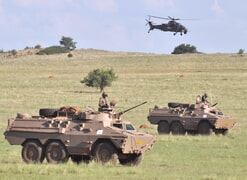
Revolution: Chapter 12 - Defending the Nation
By the fifth year after the coup, the Council turned its attention to a sector long neglected, yet essential to any sovereign nation: defence.


Next to the cement step at the kitchen door was a foot scraper. This was a series of metal strips spaced about an inch apart on which to scrape off the mud from the soles of our shoes. When that side of the house was in shade, I sometimes liked to sit on this back step beside the foot scraper, daydreaming and enjoying the coolness.
On one such occasion, I was sitting there idly examining a red bottle top when it occurred to me that, for all I knew, someone else might perceive this colour as blue but call it red, and think red is actually blue. It struck me that there was no way of experiencing perceptions, sensations and emotions other than one’s own. Once the idea had begun to sink in I was shocked by what it implied. It meant that every individual is fundamentally alone, from the womb to the grave.
This thought has stayed with me since childhood, and I have re-examined it over the years. I still believe it is impossible to know with certainty what somebody else feels, and this creates an unbridgeable gap, no matter how intimately one relates to another individual.
To view my longer work as an author, you can find me on Smashwords here.
This is my writer's blog and it's a pleasure to have your company. You’ll see that the site is designed to showcase my writing.
View ProfileXplorio is your local connection allowing you to find anything and everything about a town.
Read MoreBy the fifth year after the coup, the Council turned its attention to a sector long neglected, yet essential to any sovereign nation: defence.
By 2031, as the housing and agricultural sectors surged forward, the Council turned its attention to another pillar of national recovery: healthcare.
The Second Address to the Nation, delivered on 15 December 2026, was the most widely watched broadcast in South Africa's modern history.
The the close of 2027, a year after the September Intervention, the effects of the Council's reforms had begun to reshape South African society in visible and measurable ways. While challenges persisted, there was a growing sense that the machine...
By the second year of the Council's stewardship, it had become evident that South Africa's future depended not merely on political stability or economic revival, but on the quality of its education system.
By the third anniversary of the September Revolution, the Council's achievements in restoring governance, stabilising the economy, and revitalising eduction had begun to bear fruit. Yet, as Harvey Jacobs repeatedly emphasised, "a nation cann...