



Revolution: Chapter 12 - Defending the Nation
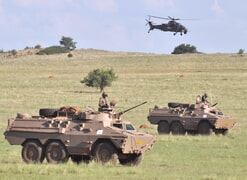
By the fifth year after the coup, the Council turned its attention to a sector long neglected, yet essential to any sovereign nation: defence.

“I’ve just had an SMS.”
“From?”
“Takeabody. Listen to this: ‘Good day. Collection of your husband’s body has been scheduled for no later than 5pm on Thursday 25 June. Please ensure that the corpse is in a hygienic state and lying in a supine position with straightened limbs.’”
“Thursday? But that’s tomorrow. It must be a mistake; I’ve been feeling fine of late. Or maybe it’s a scam. They send a fake Takeabody message, and when you respond, they offer to move the date if you pay a large amount into their account.”
“There’s a reference number. It looks authentic.”
“Well, if it is genuine, Their AI forecaster must foresee a heart attack, or a stroke, or something. At least, if it’s true, I won’t suffer a lingering death.
“We will just have to wait and see. What else can we do?”
“We can’t just sit around waiting. Let’s go out for a meal, and when we get back I’ll take some Viagra. How about it?”
“All right. You always said you wanted to go with a bang and not a whimper.”
From Fairy Tales and Nursery Rhymes.
To view my longer work as an author, you can find me on Smashwords here.
This is my writer's blog and it's a pleasure to have your company. You’ll see that the site is designed to showcase my writing.
View ProfileXplorio is your local connection allowing you to find anything and everything about a town.
Read MoreBy the fifth year after the coup, the Council turned its attention to a sector long neglected, yet essential to any sovereign nation: defence.
By 2031, as the housing and agricultural sectors surged forward, the Council turned its attention to another pillar of national recovery: healthcare.
The Second Address to the Nation, delivered on 15 December 2026, was the most widely watched broadcast in South Africa's modern history.
The the close of 2027, a year after the September Intervention, the effects of the Council's reforms had begun to reshape South African society in visible and measurable ways. While challenges persisted, there was a growing sense that the machine...
By the second year of the Council's stewardship, it had become evident that South Africa's future depended not merely on political stability or economic revival, but on the quality of its education system.
By the third anniversary of the September Revolution, the Council's achievements in restoring governance, stabilising the economy, and revitalising eduction had begun to bear fruit. Yet, as Harvey Jacobs repeatedly emphasised, "a nation cann...