



Revolution: Chapter 12 - Defending the Nation
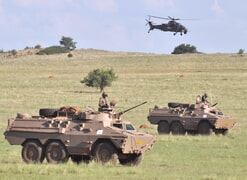
By the fifth year after the coup, the Council turned its attention to a sector long neglected, yet essential to any sovereign nation: defence.
The operation that would later be known as The September Intervention unfolded with a precision that surprised even its architects. For months, fragments of the plan had been tested through simulations and contingency exercises. When the order was finally given in the early hours of Monday, 7 September 2026, every participant knew their role and the moral justification behind it: the preservation of the nation itself.
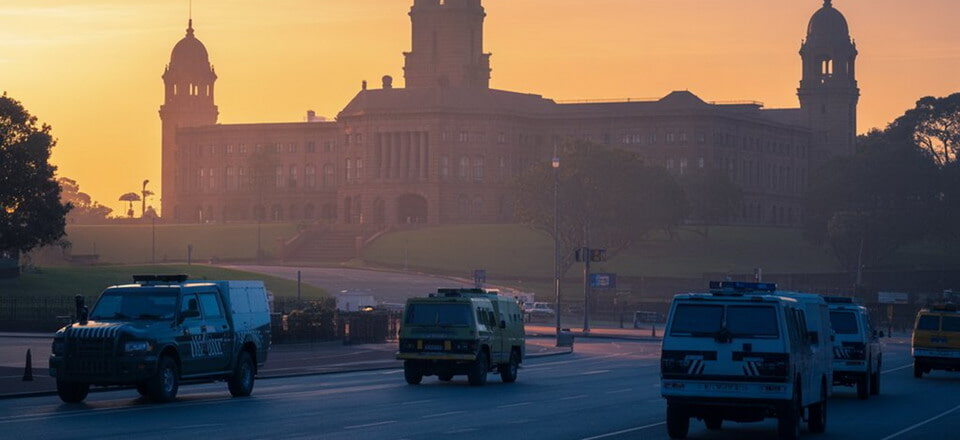
At 3:00 a.m., convoys of unmarked vehicles moved quietly through Pretoria, Johannesburg, and Cape Town. Units composed of sympathetic elements from the SANDF, tactical police divisions, and contracted private security teams converged on key installations - the Union Buildings, the SABC headquarters, National Treasury, and the South African Reserve Bank. Communications networks were secured; mobile and internet access were temporarily disrupted to prevent disinformation and counter-organising.
By dawn, all principal government ministries were under Council control. The transition was so swift and bloodless that most citizens awoke unaware that a seismic change had occurred. Senior ANC officials, including the president and cabinet members, were escorted from their residences and placed under house arrest in locations prearranged for safety and transparency. The announcement would come later that morning, but the state was already in new hands.
At 7:00 a.m., Dr. Harvey Jacobs arrived at the SABC studios in Auckland Park. Dressed in a simple dark suit, he appeared calm but solemn. His prepared speech had been revised multiple times through the night, the final version stripped of rhetoric and composed in the tone of necessity. Shortly after 8:00, the SABC, eNCA, and all major radio networks broadcast the message live:
“Fellow South Africans,
In the early hours of this morning, your Defence Force and your Police Service, acting in concert with civic and business leaders, have taken temporary custodianship of the Republic. This step has been taken to prevent the total collapse of the state, to restore law and order, and to begin a process of national renewal.
The previous government is under protective custody. There has been no bloodshed, no arrests for political opinion, and no interference with civil life. Our objective is not to destroy democracy, but to safeguard the nation so that true democracy may one day return, cleansed of corruption and fear.
Effective immediately, the Constitution is suspended, and a State of Emergency is declared. The Council for National Renewal will assume executive authority until the country is stabilised and a new framework of governance is established. Essential services will continue uninterrupted.
I appeal to all citizens to remain calm, to go to work, to protect one another, and to remember that we are one people bound by a shared destiny. We act not for power, but for peace. In the coming days, I shall address the nation again to explain the road ahead - The Way Forward.
May wisdom guide us all.”
The effect of Jacobs’s broadcast was electric. Within hours, the announcement had reached every corner of the country. There were isolated protests - particularly from diehard ANC loyalists and left-wing student organisations - but the overwhelming mood was one of weary acceptance, even relief. Ordinary citizens, long disillusioned by endless scandals and failing institutions, greeted the news as a strange kind of deliverance.
In the days that followed, the Council’s rapid actions reinforced that sense of order. Checkpoints were set up at major intersections, curfews were imposed in high-risk zones, and the looting that had erupted sporadically in the previous weeks was brought under control. The media, now operating under a temporary information directive, reported cautiously but consistently on the return of stability.
Behind the scenes, Jacobs and his close advisors worked around the clock to consolidate authority without provoking international outrage. Diplomatic cables were sent to Washington, London, and Brussels assuring foreign governments that South Africa remained committed to democratic principles and the protection of investments. To the astonishment of many observers, the global response was muted - a combination of fatigue with the ANC’s misgovernance and a pragmatic recognition that stability served everyone’s interests.
By mid-September, the initial crisis had passed. Government salaries were paid on time, electricity generation stabilised as technicians returned to work, and the rand, after a brief dip, began to recover.
The Council then turned inward, facing the formidable task of governing. The First Full Council Meeting, held at the Union Buildings on 18 September 2026, marked the beginning of what historians would later call The Reconstruction Era. There, in the cabinet room stripped of party insignia, the fifty members - half men, half women - pledged to steer the nation towards renewal under the guidance of reason and justice.
The coup, in retrospect, had been the easy part. The rebuilding - The Way Forward - would test their ideals and the endurance of an entire people.
Read Revolution Chapter 1 here.
Read Revolution Chapter 2 here.
To view my longer work as an author, you can find me on Smashwords here.
This is my writer's blog and it's a pleasure to have your company. You’ll see that the site is designed to showcase my writing.
View ProfileXplorio is your local connection allowing you to find anything and everything about a town.
Read MoreBy the fifth year after the coup, the Council turned its attention to a sector long neglected, yet essential to any sovereign nation: defence.
By 2031, as the housing and agricultural sectors surged forward, the Council turned its attention to another pillar of national recovery: healthcare.
The Second Address to the Nation, delivered on 15 December 2026, was the most widely watched broadcast in South Africa's modern history.
The the close of 2027, a year after the September Intervention, the effects of the Council's reforms had begun to reshape South African society in visible and measurable ways. While challenges persisted, there was a growing sense that the machine...
By the second year of the Council's stewardship, it had become evident that South Africa's future depended not merely on political stability or economic revival, but on the quality of its education system.
By the third anniversary of the September Revolution, the Council's achievements in restoring governance, stabilising the economy, and revitalising eduction had begun to bear fruit. Yet, as Harvey Jacobs repeatedly emphasised, "a nation cann...