




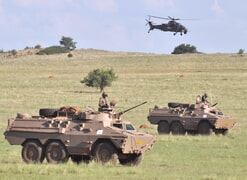
Revolution: Chapter 12 - Defending the Nation
By the fifth year after the coup, the Council turned its attention to a sector long neglected, yet essential to any sovereign nation: defence.
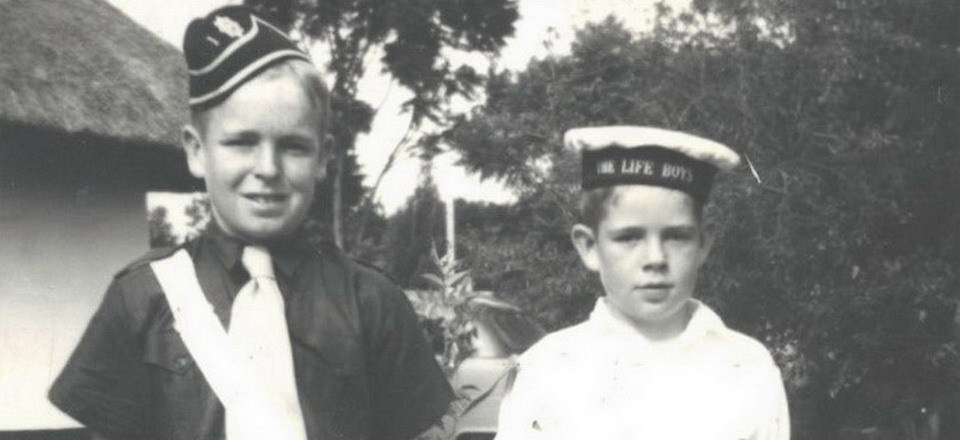

Here we are standing in roughly the same position as in the previous photograph, but two or three years has elapsed. Alan is in his Boys Brigade uniform, and I am wearing a Life Buoy cap.
My parents had survived the Second World War, in which unspeakable atrocities had been committed on a grand scale, and they were convinced that Good had triumphed over Evil. They believed that solid British values had enabled them to withstand invasion and ultimately defeat the enemy. They felt it their duty to inculcate these same values in their children that they might grow up to be honest, hard-working and patriotic. So when, in 1955, eight-year-old Alan expressed an interest in becoming a Boy Scout, they encouraged him to join the movement.
A Scout had to swear an oath to do his duty to God and his country, and to obey the Scout Law, which required one to help other people at all times, and to keep oneself physically strong, mentally awake and morally straight. Not only that, he also had to be trustworthy, loyal, helpful, friendly, courteous, kind, obedient, cheerful, thrifty, brave, clean and reverent. Finally, as if all that was not enough, the boy had to promise to do a good turn daily.
Alan was too young to be a Scout and take on such a burden of responsibility, and instead became a Cub, which is the male equivalent of a Brownie in the Girl Guides. He enjoyed himself without getting into trouble until the family left Fish Hoek and went to Rhodesia at the end of 1956.
I don’t think there were Boy Scouts in Gwelo, but instead there was Boys’ Brigade, which was a similar organisation based on Christian principles and military discipline. We joined when Alan was thirteen and I was eight or nine, and all went well for a short time. However, being rebellious by nature, my brother soon fell foul of authority.
Meetings were held in the Presbyterian Church Hall, and each session started with a prayer and then marching, two abreast, several times around the perimeter of the room. On the fateful evening in question, all the boys were dutifully swinging their arms and striding in time like parade ground soldiers, when Alan got it into his head to start shouting instructions like a sergeant major.
“Left, right, left, right. Kill the bloody Germans, kill the bloody Japs. Left, right, left, right.”
This went on for a short while until Mr Morris, the Brigade Officer, rushed into the hall and demanded to know who had been shouting like that. Alan stepped forward.
“You are a disgrace!” the furious man snarled. Ï do not want to see you here ever again. Now, GO!”
And that was the end of Boys’ Brigade.
To view my longer work as an author, you can find me on Smashwords here.
This is my writer's blog and it's a pleasure to have your company. You’ll see that the site is designed to showcase my writing.
View ProfileXplorio is your local connection allowing you to find anything and everything about a town.
Read MoreBy the fifth year after the coup, the Council turned its attention to a sector long neglected, yet essential to any sovereign nation: defence.
By 2031, as the housing and agricultural sectors surged forward, the Council turned its attention to another pillar of national recovery: healthcare.
The Second Address to the Nation, delivered on 15 December 2026, was the most widely watched broadcast in South Africa's modern history.
The the close of 2027, a year after the September Intervention, the effects of the Council's reforms had begun to reshape South African society in visible and measurable ways. While challenges persisted, there was a growing sense that the machine...
By the second year of the Council's stewardship, it had become evident that South Africa's future depended not merely on political stability or economic revival, but on the quality of its education system.
By the third anniversary of the September Revolution, the Council's achievements in restoring governance, stabilising the economy, and revitalising eduction had begun to bear fruit. Yet, as Harvey Jacobs repeatedly emphasised, "a nation cann...