



Finding Safety in Your Own Body
Our bodies are the container within which we live.

Why your body still reacts to the narcissist long after they are gone.
When we leave a narcissistically abusive relationship, many people believe that the danger has passed and that healing should naturally follow.
Yet many survivors are confused when their body continues reacting long after the relationship has ended.
A tone of voice.
A sudden movement.
A certain word or smell.
And suddenly your body feels fear, tension, or anxiety before your mind even understands what is happening.
This happens because during a narcissistically abusive relationship your body becomes your brain.
Your nervous system becomes your primary survival system.
You learn to depend on subtle internal signals of danger. Even when you are not consciously alert, your body is constantly scanning the environment. It becomes the silent protector that warns you when something feels unsafe.
Over time your nervous system creates a default setting of danger.
Life begins to feel unpredictable and unsafe, and the body learns that it must remain ready for the next emotional attack.
Many people in healthy environments operate from a very different internal setting. Their nervous system has a default of safety. Yes, they experience stress or fear at times, but deep within they know those moments will pass. Fear is not their normal state.
For the survivor of narcissistic abuse, the body has simply learned a different pattern.
The good news from neuroscience is this:
The nervous system can learn safety again.
Through awareness, emotional healing, and nervous system regulation, the body slowly begins to recognise that the present moment is no longer the past.
Healing from narcissistic abuse is therefore not only about understanding what happened.
It is about helping the body rediscover something it once knew very well:
Peace.
Before the relationship you knew what it felt like to experience love, laughter, joy and safety.
You have not lost it.
Your body has simply unlearned it for survival, and what was learned can be learned again.
When the nervous system begins to relax, survivors often experience something extraordinary:
The return of calm.
The return of joy.
The return of love.
And slowly, a beautiful life begins to unfold again — one no longer ruled by fear, doubt, guilt or hurt.
You were never meant to remain in survival.
You were meant to become whole again and to build a life filled with what your heart most deeply desires.
Quote
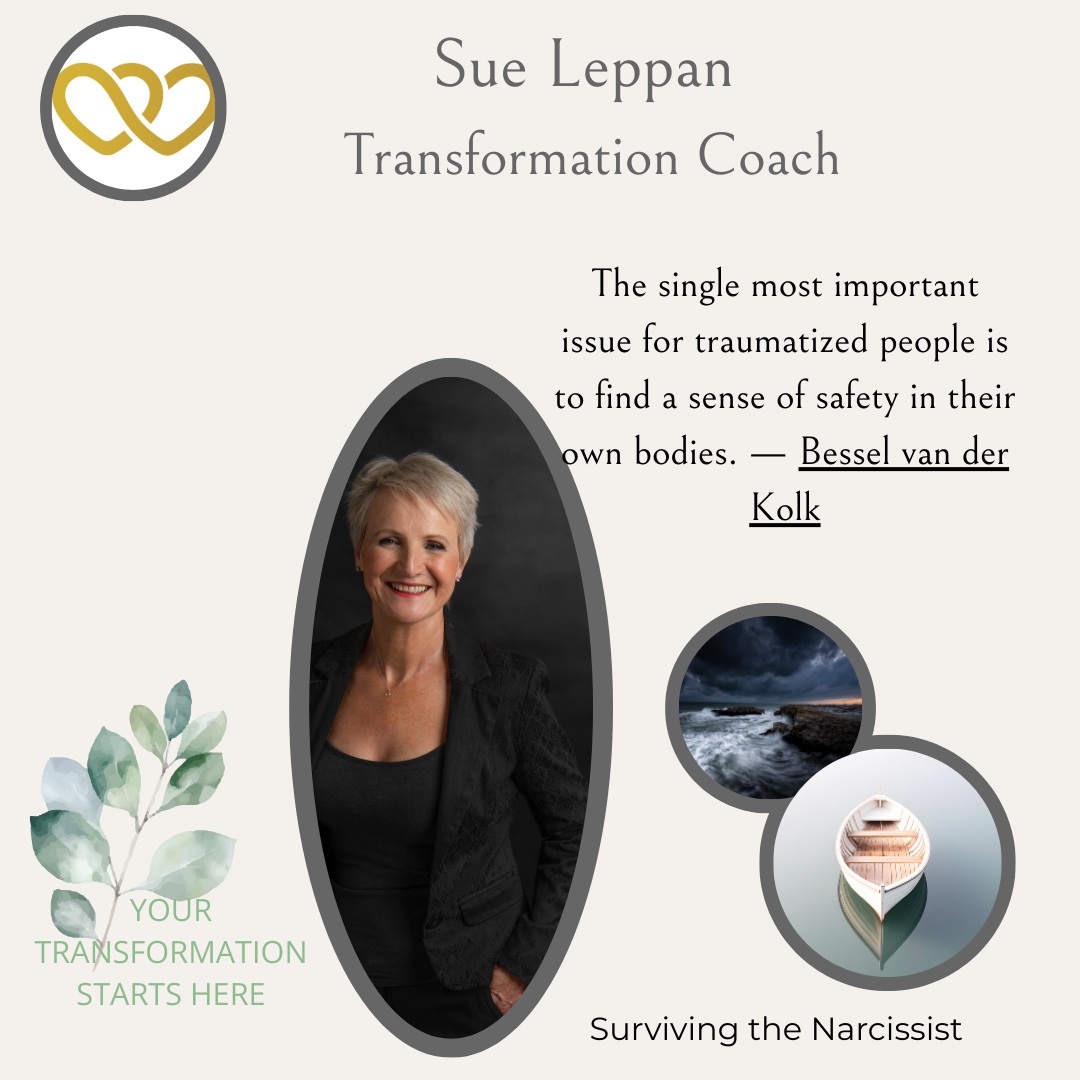
Part of the healing after a narcissistic relationship is to retrain your body to feel safe and no longer be the “survival brain”.
Sue Leppan is a life, transformation and holistic wellness coach based in Sandbaai, Hermanus. Providing therapy for a range of challenges, Sue specialises in targeting and dealing with emotional trauma, self-doubt, depression, stagnation and self-centring. Whether you need help with personal issues ...
View ProfileXplorio is your local connection allowing you to find anything and everything about a town.
Read MoreOur bodies are the container within which we live.
There comes a moment after leaving a narcissistically abusive relationship when you realise something unexpected.
Leaving a narcissistic abusive relationship often brings a moment where people say to you, “At least the worst is over.”
Many people believe their anger simply “happens”.
What if the enemy you are fighting is not outside of you?