




How Your Attention Shapes Your Life
All your actions will flow to where your attention is.

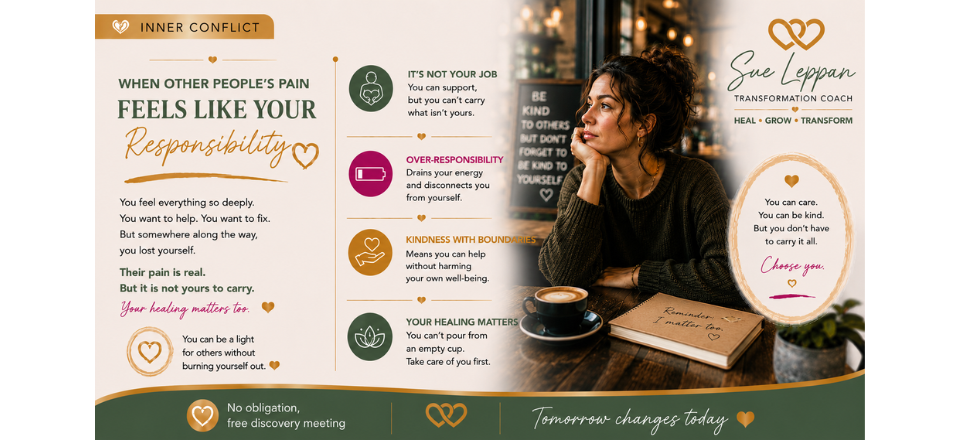
As we continue this week's journey into self-love and self-kindness, we move beyond the patterns of over-giving and the difficulty of establishing healthy boundaries. We arrive at a deeper question, one that many people have never stopped to ask themselves:
Why do I feel so responsible for other people's pain?
For some, this question may feel uncomfortable. Compassion is often viewed as a virtue, and rightly so. The ability to care about others, to empathise with their struggles and to offer support during difficult times is one of humanity's greatest strengths. Yet there is a significant difference between caring about someone's pain and carrying it as though it belongs to you.
Many people move through life feeling emotionally responsible for everyone around them. They feel responsible when a friend is struggling. They feel responsible when a family member is unhappy. They feel responsible when a partner is stressed, angry or disappointed. Even when circumstances are completely beyond their control, they somehow find a way to absorb the emotional burden.
Over time, this can become exhausting.
The mind rarely rests because it is constantly occupied with other people's challenges. The nervous system remains activated because there is always another problem to solve, another person to rescue or another emotional crisis demanding attention. Eventually, a person can become so focused on managing the well-being of others that they lose sight of their own emotional needs entirely.
What makes this pattern particularly difficult to recognise is that it often disguises itself as kindness.
The person genuinely cares. They genuinely want to help. They genuinely want to ease the suffering of those around them.
However, beneath the compassion, there is sometimes another story.
Many people who carry the pain of others know what it feels like to carry pain themselves.
They know what it feels like to feel unseen.
They know what it feels like to feel unsupported.
They know what it feels like to struggle emotionally while longing for someone to understand.
Because of this, they become highly attuned to the suffering of others. They notice what many people miss. They sense emotional pain quickly. They recognise loneliness, rejection, fear and sadness because they have experienced those emotions themselves.
The difficulty arises when they begin trying to heal their own wounds by rescuing others.
Without realising it, helping others becomes a way of searching for something they have not yet given themselves. It becomes a way of finding purpose, validation, significance or connection. The focus remains outward because looking inward feels unfamiliar, uncomfortable or even selfish.
This is where the inner conflict becomes visible.
A person can spend years caring for everyone around them while neglecting the person who needs their care the most.
Themselves.
The deeper question is not whether helping others is good or bad.
The deeper question is:
What is lacking within me that I feel compelled to carry everyone else's pain?
The answer will be different for every person.
For some, it may be self-worth.
For others, it may be acceptance.
For some, it may be love.
For others, it may be the simple recognition that their needs matter too.
Self-love invites us to examine this pattern with honesty rather than judgement. It encourages us to ask whether we are helping from abundance or from emptiness. Are we supporting others because we genuinely choose to, or because we are unconsciously searching for something through our giving?
When we begin developing a healthier relationship with ourselves, something profound happens. We stop carrying responsibilities that were never ours to carry. We learn that compassion does not require self-sacrifice. We discover that we can care deeply without becoming emotionally responsible for everyone else's healing journey.
Most importantly, we begin offering ourselves the same kindness we so willingly offer others.
That is not selfish.
That is balance.
That is wisdom.
And that is where true self-love begins to emerge.
As you reflect today, ask yourself:
When was the last time you offered yourself the same compassion, understanding and care that you so naturally extend to everyone else?
Sue Leppan is a life, transformation and holistic wellness coach based in Sandbaai, Hermanus. Providing therapy for a range of challenges, Sue specialises in targeting and dealing with emotional trauma, self-doubt, depression, stagnation and self-centring. Whether you need help with personal issues ...
View ProfileXplorio is your local connection allowing you to find anything and everything about a town.
Read MoreAll your actions will flow to where your attention is.
We can become trapped in our inner battle because one part of us is still fighting what we want to break free from...
How does your current state serve you?
Emotional pain and inner conflict is not your only option.
Nothing changes outside unless it changes inside first.
You are irreplaceable - do you treat yourself as such?