



How to Overcome Limiting Beliefs and Become t...
There is a longing inside of you waiting to break through to the surface. It is the true you calling.

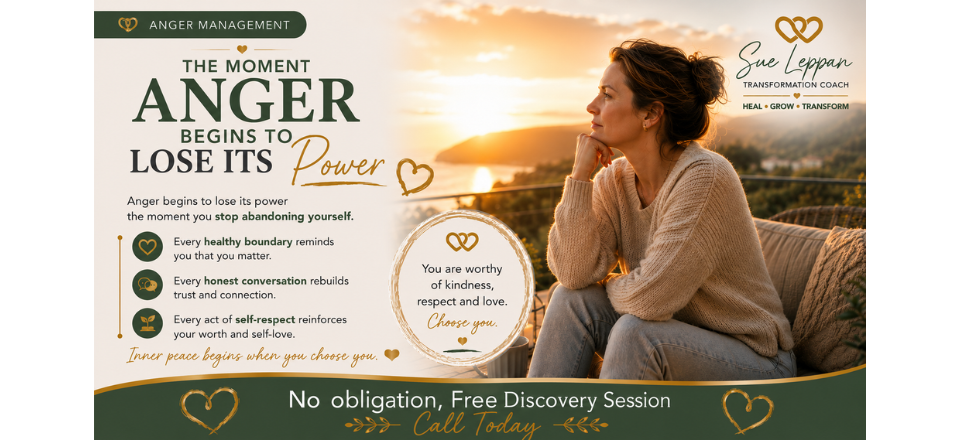
There comes a moment in every healing journey when we realise that waiting for other people to change is keeping us trapped. We wait for our employer to appreciate us, our partner to understand us, our family to recognise our efforts, our clients to respect our boundaries or life itself to become fair. While these are understandable desires, they often place our emotional wellbeing into someone else's hands. The result is a life where our peace is continually determined by circumstances we cannot control.
This is where anger quietly continues to grow.
As long as your sense of worth depends upon how other people treat you, every act of disrespect, criticism or rejection has the power to shake your emotional foundation. You begin reacting to life instead of leading it. Every difficult interaction feels personal because, deep within, it confirms the subconscious belief that perhaps you are not enough. Anger becomes the armour protecting a heart that has forgotten its own value.
The turning point in anger management is not learning how to suppress your reactions. It is recognising that your emotional freedom begins the moment you stop asking the outside world to tell you who you are. Lasting peace is not created by controlling other people. It is created by transforming the relationship you have with yourself. When you know your worth, you no longer need to fight for it.
Many people believe that self-worth is something they must build through achievement. They believe they will finally feel valuable when they earn more money, lose weight, find the right relationship, grow a successful business or receive recognition from those around them. Yet these external achievements can never permanently heal an internal belief of unworthiness. If your value depends upon what you accomplish or what others think of you, your peace will always remain fragile because it is built upon conditions that constantly change.
Psychology reminds us that our relationship with ourselves becomes the blueprint for every other relationship we create. If we consistently dismiss our own needs, minimise our feelings or tolerate behaviour that dishonours us, we unintentionally teach others to do the same. This is not because people are intentionally cruel. It is because human beings naturally respond to the boundaries we consistently communicate. The respect we receive from others often begins with the respect we demonstrate towards ourselves.
Neuroscience shows us that the brain cannot easily distinguish between what we repeatedly experience externally and what we repeatedly tell ourselves internally. Every time you ignore your own intuition, criticise yourself harshly or convince yourself that your needs are less important than everyone else's, your brain strengthens those neural pathways. Over time, self-neglect becomes familiar, and familiar begins to feel normal. The encouraging news is that neuroplasticity allows these pathways to change. Every decision made from self-respect creates new neural connections that gradually replace fear with confidence and self-doubt with emotional safety.
This is where Neuro-Linguistic Programming offers profound insight. The subconscious mind responds to repetition, emotion and meaning. For years you may have unconsciously repeated messages such as, "I don't want to disappoint anyone," "My needs can wait," "I must keep the peace," or "If I speak up, people may reject me." These beliefs quietly shaped your identity and your behaviour. Claiming your self-worth begins by changing the meaning you give to yourself. Instead of seeing boundaries as selfish, you begin seeing them as acts of self-respect. Instead of viewing your voice as a threat to relationships, you begin recognising it as an expression of authenticity. Instead of believing your value must be earned, you begin understanding that your worth has always existed.
From a quantum perspective, transformation occurs from the inside out. Before your external world changes, your internal state begins to shift. You think differently because you see yourself differently. You speak differently because you value yourself differently. You make different decisions because you are no longer being driven by fear. This change in consciousness naturally alters the energy you bring into every relationship and every situation. You no longer enter conversations seeking approval. You enter them knowing that your value is already established.
Claiming your self-worth does not mean becoming argumentative or refusing to compromise. It does not mean becoming emotionally distant or believing that your opinions are more important than those of others. True self-worth is remarkably calm. It allows you to listen without losing yourself. It allows you to disagree without becoming defensive. It allows you to say "no" without guilt and "yes" without resentment. It gives you permission to be compassionate towards others while remaining deeply compassionate towards yourself.
This is the point where anger begins to lose its purpose.
When you stop abandoning yourself, there is less injustice for your anger to defend.
When you begin speaking honestly, there is less resentment to suppress.
When you honour your own boundaries, there are fewer emotional wounds accumulating beneath the surface.
When you treat yourself with kindness and respect, your nervous system begins to experience something it may have been longing for over many years—safety. From that place of safety, your responses become intentional rather than reactive. You no longer feel compelled to prove your worth because you already know it.
Perhaps the most beautiful part of this journey is discovering that the person you have been searching for has always been you. The confidence you wanted from others, the acceptance you longed to receive and the respect you hoped someone else would offer all begin within. As you strengthen your relationship with yourself, anger gradually gives way to clarity, fear gives way to courage and self-denial gives way to self-respect.
Today, I invite you to ask yourself a different question. Rather than asking, "How do I stop feeling angry?", ask "How can I honour myself more fully today?" The answer may be a difficult conversation, a healthy boundary, a decision you have been postponing or simply offering yourself the same kindness you so readily give to everyone else.
The journey towards emotional freedom does not begin when other people change.
It begins the moment you recognise that your worth has never been theirs to decide.
And that moment changes everything.
Sue Leppan is a life, transformation and holistic wellness coach based in Sandbaai, Hermanus. Providing therapy for a range of challenges, Sue specialises in targeting and dealing with emotional trauma, self-doubt, depression, stagnation and self-centring. Whether you need help with personal issues ...
View ProfileXplorio is your local connection allowing you to find anything and everything about a town.
Read MoreThere is a longing inside of you waiting to break through to the surface. It is the true you calling.
Your anger never came as punishment.
Perhaps you've said them about your anger.
Anger can be a very good motivator.
You were never supposed to become the anger.
Anger is a very human response.