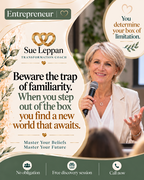





Know What You Want: Your First Step to Busine...
You need a map, and you hold it within.
There comes a moment in every journey of personal growth when we begin to ask different questions.
Not because life has suddenly become easier, but because we have grown tired of finding the same ending in different stories.
After asking, "Why does this keep happening to me?", another possibility begins to emerge. It is often uncomfortable because it gently shifts our attention away from everyone else and back towards ourselves. It is not a question of blame, nor is it an attempt to excuse the behaviour of those who have hurt us. Rather, it is an invitation to become curious about something we rarely consider.
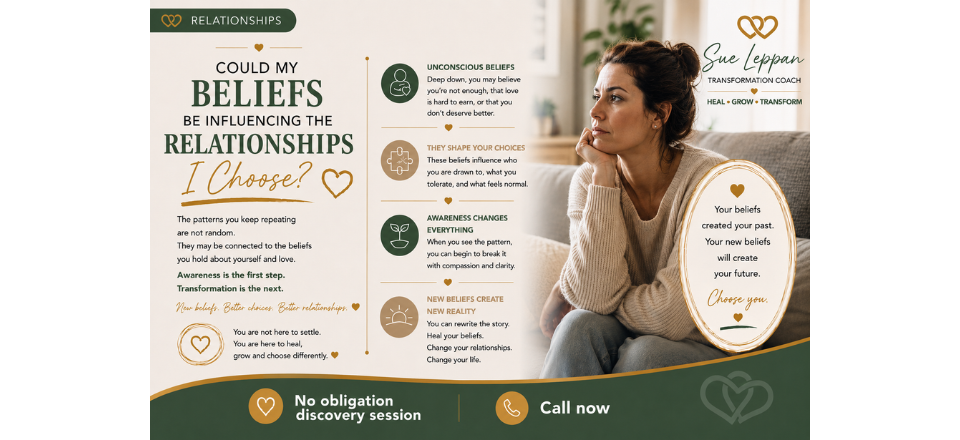
Could the beliefs I hold about relationships be influencing the relationships I choose and the way I experience them?
Most of us never stop to think about what we actually believe about love, friendship, trust or partnership. We assume our beliefs are facts because we have lived with them for so long. They become the invisible lens through which we see every relationship, interpret every conversation and respond to every situation.
Perhaps somewhere along life's journey you learned that people cannot be trusted.
Perhaps you came to believe that love always comes with conditions.
Maybe you discovered that expressing your needs leads to rejection, that conflict means the relationship is ending, or that you have to work tirelessly to earn someone's affection and approval.
These beliefs rarely arrive through one dramatic event. More often, they are formed quietly through repeated experiences, childhood relationships, painful disappointments or moments when you felt unseen, unheard or unworthy. Over time they settle into the subconscious mind where they begin directing your life without asking for your permission.
Psychology teaches us that the subconscious is designed to protect us. Its purpose is to keep us safe by recognising familiar patterns and encouraging predictable responses. The difficulty is that the subconscious does not distinguish between what is familiar and what is healthy. If uncertainty, disappointment or emotional distance became familiar early in life, they can begin to feel strangely normal, even when they no longer serve you.
Neuroscience helps us understand why these patterns become so deeply rooted. Every repeated thought strengthens the neural pathways associated with it. The more often you think, "People always let me down," the more easily your brain recognises evidence that appears to support that belief. Before long, you are no longer seeing relationships as they truly are. You are seeing them through the expectations your mind has learned to anticipate.
NLP reminds us that our internal beliefs shape our language, our emotions and ultimately our behaviour. We do not simply think our beliefs; we live them. They influence the questions we ask, the meanings we attach to other people's actions and the choices we make every day. Even our body language, tone of voice and emotional responses begin reflecting the story we have been telling ourselves for years.
This is why relationships often become mirrors rather than mysteries.
The people who enter our lives do not create our beliefs, but they frequently reveal them.
Someone takes longer than usual to reply to a message, and suddenly anxiety appears.
A partner asks for space, and fear immediately whispers that you are about to be abandoned.
Someone offers genuine kindness, yet you find yourself questioning their motives because trusting feels unfamiliar.
These reactions are seldom about the present moment alone. They are often echoes of beliefs that have quietly travelled with us from the past.
Perhaps the greatest act of courage is not trying harder to find the perfect relationship.
Perhaps it is becoming willing to examine the beliefs you have carried into every relationship.
Imagine the freedom that comes from recognising that a belief is not the same as the truth.
A belief can be questioned.
A belief can be challenged.
A belief can be replaced.
And when a limiting belief is released, something remarkable begins to happen. You no longer feel compelled to protect yourself from a future that has not yet happened. You begin responding to people as they are, rather than as your past has taught you to expect them to be. Relationships become less about surviving and more about connecting.
This is where transformation truly begins.
Not by changing everyone around you.
But by changing the invisible beliefs that have quietly been shaping your experience of every relationship.
Because when your beliefs change, your choices change.
When your choices change, your relationships change.
And when your relationships change, your future changes with them.
Sue Leppan is a life, transformation and holistic wellness coach based in Sandbaai, Hermanus. Providing therapy for a range of challenges, Sue specialises in targeting and dealing with emotional trauma, self-doubt, depression, stagnation and self-centring. Whether you need help with personal issues ...
View ProfileXplorio is your local connection allowing you to find anything and everything about a town.
Read MoreYou need a map, and you hold it within.
When you step out of the box, you discover a new world that awaits.
You are wiser and more skilled now.
Remember why you started.
Create a familiarity of success.
How you feel and think influences your business.