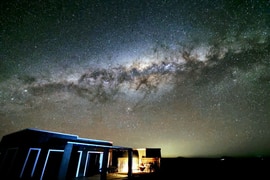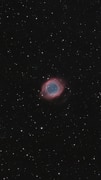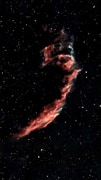





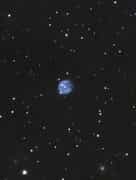
NGC 246 Skull Nebula Captured from Pearly Bea...
NGC 246 (also known as the Skull Nebula or Caldwell 56) is a planetary nebula in the constellation Cetus (The Whale), discovered by William Herschel in 1785.

Had half a gap last night and wanted to take a look at Nova Musca but conditions were not good in that region. Slewed to eta Car and NGC 2070 (Tarantula), two famous southern hemisphere deep-sky objects that were slightly higher above the horison, with somewhat better seeing. As can be seen I've still to make a focusing mask! Eta is a total of 2 minutes exposure time and NGC 2070, 4 minutes. Used a high ISO value, and even though dark frames were used, there's still lots of noise.
Eta Carinae Nebula (NGC 3372): Situated midway between the Southern Cross and the False Cross, this bright patch along the southern Milky Way, is visible with the naked eye. The brightest star, located in the norhtern part of the nebula, is the mysterious star eta Carinae, one of the most massive and luminous stellar systems known in the Galaxy. West of eta Carinae is the keyhole-shaped dark nebula, the remnants of a molecular cloud from which some of the sourrounding stars were formed. The nebula is situated around 7 000 light years from us.
Tarantula Nebula (NGC 2070): Visible to the naked eye as a bright patch on the eastern side of the Large Magellanic Cloud, this emission nebula spans over 900 light years of space. One of the most massive star-forming regions known to us, it is 500 times more energetic then the Orion Nebula (M42). The nebula's famous loops and curls were formed by past supernova explosions that created rapidly expanding shells of ionized matter.
Southern Cape Astronomy Club meets at least once a month for stargazing or observation evenings close to new Moon or during astronomical related events. The well-established club is based in Pearly Beach just outside Gansbaai.
View ProfileXplorio is your local connection allowing you to find anything and everything about a town.
Read MoreNGC 246 (also known as the Skull Nebula or Caldwell 56) is a planetary nebula in the constellation Cetus (The Whale), discovered by William Herschel in 1785.
Please note, this is not an AI-generated site.
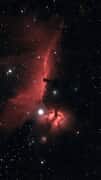
Just a quick stack of a few DSO's from the early hours on Sunday morning (11/10/2026).
Three images with an S30 Pro on EQ mode from last night (04/1/2026).
With the Moon out of the way and weather improving somewhat, there was a few hours gap last night for collecting a few photons.
We've had some good weather the last couple of weeks; here are a few astro images.