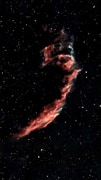





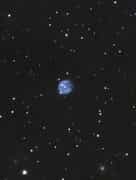
NGC 246 Skull Nebula Captured from Pearly Bea...
NGC 246 (also known as the Skull Nebula or Caldwell 56) is a planetary nebula in the constellation Cetus (The Whale), discovered by William Herschel in 1785.

First Quarter Moon from Pearly Beach Observatory.
One of the most obvious features of the Moon is that it passes through a number of phases from New Moon to Full Moon and back every 29.53 day (synodic month). It makes a full circle relative to the background stars every 27.32 days (sidereal month), moving its own apparent diameter (half a degree) in slightly over one hour. This motion is easily noticeable when it occults a brigh star or planet. On the 1st as well as on the 28th March, the brightest star in the constellation Leo, alpha Leonis or Regulus is occulted by the Moon. Unfortunately both these events will not be visible from Southern Africa. The line separating sunlight from shadow, is called the terminator, and has nothing to do with Arnold Schwarzenegger and Hollywood. Observing with a telescope this movement can easily be seen by looking at various features on the lunar surface such as mountain peaks and craters. More detail is visible near the terminator as opposed to viewing the lunar surface when it is fully lit during Full Moon when many of the craters are washed out by sunlight, some even disspearing from view entirly.
The surface of the Moon has dark and bright markings; flat lava plains and rocky highlands. In many African traditions these markings are said to resemble the figure of a man or woman carrying a bundle of sticks. In other cultures, a rabbit or bunny amongst other shapes such as a man is pointed out.
Southern Cape Astronomy Club meets at least once a month for stargazing or observation evenings close to new Moon or during astronomical related events. The well-established club is based in Pearly Beach just outside Gansbaai.
View ProfileXplorio is your local connection allowing you to find anything and everything about a town.
Read MoreNGC 246 (also known as the Skull Nebula or Caldwell 56) is a planetary nebula in the constellation Cetus (The Whale), discovered by William Herschel in 1785.
Please note, this is not an AI-generated site.
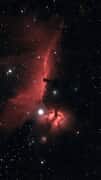
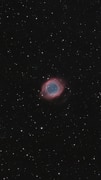
Just a quick stack of a few DSO's from the early hours on Sunday morning (11/10/2026).
Three images with an S30 Pro on EQ mode from last night (04/1/2026).
With the Moon out of the way and weather improving somewhat, there was a few hours gap last night for collecting a few photons.
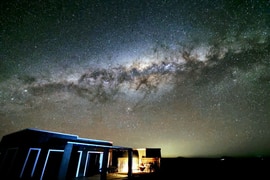
We've had some good weather the last couple of weeks; here are a few astro images.