















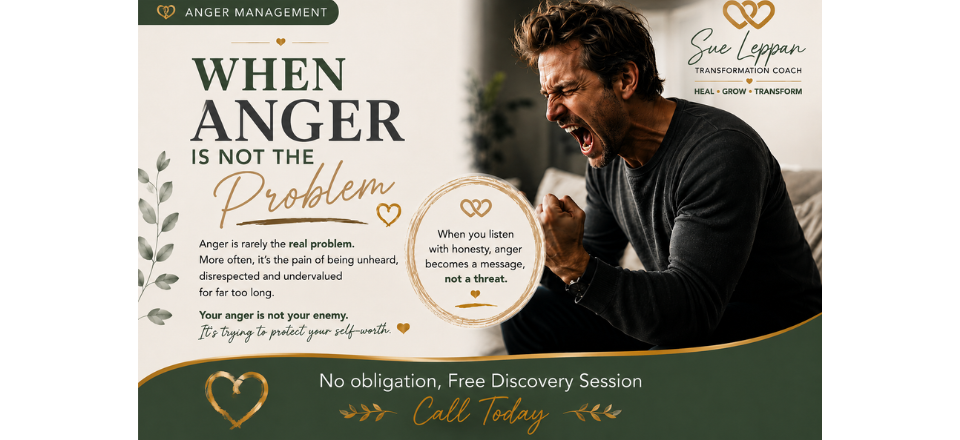

When Anger Is Not the Problem
Most people who struggle with anger are not naturally angry people. They are often caring, responsible individuals who have spent years trying to keep everyone else comfortable while quietly abandoning themselves. They avoid confrontation because they fear conflict, they compromise to preserve relationships, and they continually place the needs of others ahead of their own. On the surface, they appear calm and accommodating, yet beneath that calmness an invisible emotional pressure is building. Eventually that pressure finds a way to express itself, and when it does, anger becomes the language of pain that has remained unheard for far too long.
Whether it is in the workplace, within a marriage or relationship, in a family, or while building a business, many people unknowingly trade their self-worth for acceptance, security or approval. They remain silent when they feel disrespected because they fear losing their income, disappointing a client, being rejected by a partner, or facing the uncertainty that comes with change. The compromise may feel necessary at the time, but every moment of self-denial leaves another small wound on the relationship they have with themselves. Over time, these repeated experiences create an overwhelming sense of unfairness, and that injustice eventually manifests as frustration, resentment and anger.
Psychology teaches us that emotions are never random. Every emotion carries important information about our internal world. Anger is one of the clearest indicators that something we deeply value has been violated. It is often not the event itself that creates the emotional reaction, but the accumulation of many moments where we ignored our own needs, dismissed our own feelings or accepted treatment that conflicted with our deepest values. Anger is not simply an emotional outburst; it is often the mind's attempt to draw attention to an unresolved injustice that has existed for much longer than we realise.
Neuroscience offers further insight into why this happens. The brain is constantly assessing whether we are emotionally and physically safe. When we repeatedly silence ourselves, suppress our feelings and remain in situations where we feel powerless, our nervous system begins to operate as though it is living under continuous threat. Stress hormones remain elevated, emotional regulation becomes more difficult and the brain becomes increasingly sensitive to situations that resemble previous experiences of powerlessness. Eventually, even relatively small situations can trigger disproportionately strong emotional reactions because the nervous system is responding not only to the present moment but also to years of unresolved emotional experiences.
From the perspective of Neuro-Linguistic Programming, these emotional patterns are reinforced by the subconscious beliefs we developed throughout our lives. Many people unknowingly carry beliefs such as, "If I say no, people will reject me," "My value comes from making everyone else happy," or "Keeping the peace is more important than expressing my truth." These beliefs operate automatically beneath conscious awareness and influence our decisions, our boundaries and the way we communicate. Without recognising it, we repeatedly choose self-sacrifice over self-respect because our subconscious mind believes that self-abandonment is the safest option.
Quantum Physics reminds us that everything carries energy, including our thoughts, emotions and beliefs. Although our external circumstances may differ, the emotional state we repeatedly live from influences how we perceive the world, the decisions we make and the relationships we create. When we consistently experience ourselves as powerless, unworthy or invisible, we often continue attracting situations that reinforce those same emotional experiences. This is not because we deserve them, but because our subconscious beliefs shape the reality we repeatedly participate in. Lasting transformation therefore begins within. As our perception of our own worth changes, our choices, boundaries and relationships naturally begin to change as well.
This is why anger should never be viewed as your enemy. Anger is not proof that something is wrong with you. It is often the healthiest part of you refusing to remain silent any longer. Beneath the anger is a person who longs to feel respected, valued, heard and emotionally safe. Beneath the frustration is someone who has forgotten that their needs matter just as much as everyone else's. Anger is simply the physical expression of feeling powerless, and powerlessness always leads us back to one essential question: "What do I believe I am worth?"
Self-worth is frequently misunderstood. It is not arrogance, selfishness or believing you are better than someone else. Genuine self-worth is the quiet confidence that you deserve kindness, respect, fairness and love simply because you exist. It is recognising that your opinions matter, your feelings matter and your wellbeing matters. When you truly value yourself, you no longer need to fight for recognition because you stop giving other people permission to define your value.
As you reflect today, I invite you to consider a different question. Instead of asking yourself why you become so angry, perhaps ask where you have been making yourself smaller in order to keep the peace. Where have you accepted less than you deserve because you feared the consequences of honouring yourself? Where have you confused being loving with abandoning your own needs?
This week we will explore how reclaiming your self-worth changes everything. The journey from anger to peace is not about learning to suppress your emotions. It is about understanding what those emotions have been trying to teach you all along. When you begin to value yourself with kindness, compassion and honesty, your nervous system begins to feel safe, your relationships begin to change, and the inner war that has fuelled your anger can finally come to an end.