












The Carrington Event - the most intense solar storm in recorded history!
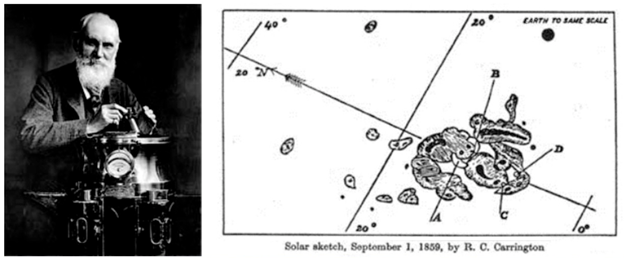
The mother of all solar storms, the most intense Space Weather event in recorded history, the Carrington event of 1 September 1859, was twice as big as any other solar storm in the last 500 years.
The British amateur astronomer, Richard Carrington, after whom the storm was named, was drawing a sketch of an enormously large sunspot region he studied through his brass telescope, when a bright flash occurred on the Sun. Within a day the coronal mass ejection emitted from the Sun reached the Earth and caused a geomagnetic storm that wreaked havoc on the technologies of the time - causing sparks on telegraph wires and electric shocks to telegraph operators. The first ever observed solar flare was associated with the largest space weather event on record.
All over the planet, as far away from the poles as South Carolina and Cuba, bright colourful auroras illuminated the nighttime skies. It seemed that the sky was on fire.
The Carrington event has become the benchmark event for solar storms by several measures. There were not many instruments that recorded the impact of the storm on Earth. A magnetometer at Greenwich Observatory in London made a pen-on-ink recording of the geomagnetic field intensity at the time. It went completely off-scale at the peak of the storm, so we do not actually know what was the peak disturbance level of the geomagnetic storm. There were no satellites at the time recoding the X-ray intensity of the flare. By comparison of the magnetogram with that of other more recent X-class flares, the soft X-ray intensity of the Carrington flare was estimated to be X45. This was significantly larger than the X35 class event of the famous Halloween storm of 2003, which was the 6th largest geomagnetic storm in history. During the Halloween storm, aurora was seen from Cape Town, and several power transformers were seriously damaged and failed prematurely within the subsequent few months.
If a storm of the intensity of the Carrington event would hit the Earth today, it would be devastating. The estimates are that it would cause “extensive social and economic disruptions” through damage to satellites, power systems, communication and navigation systems amounting to tens of trillions of Rands. On 23 July 2012 a CME of comparable strength to the Carrington Event erupted from the Sun.
Fortunately it happened on the far side of the Sun and missed the Earth.
Read more about the Carrington Superstorm event here or here.