







Astrophotography: Comet, Barnard’s Galaxy and Tarantula Nebula
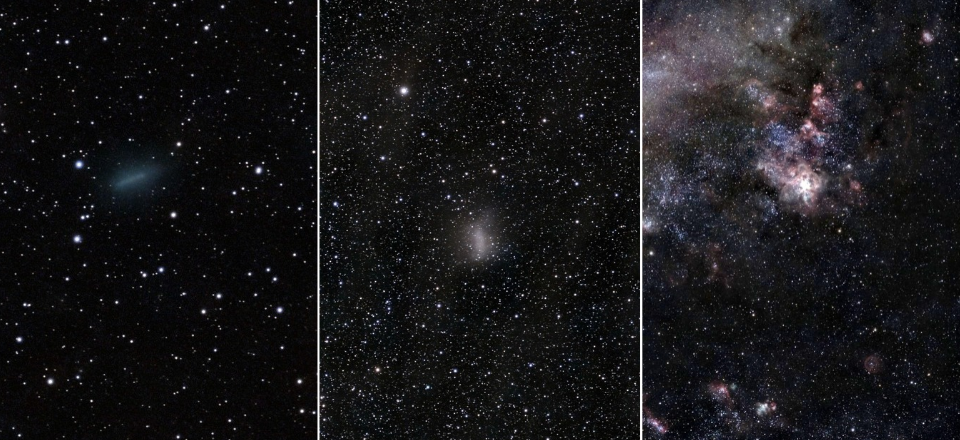
Three images with an S30 Pro on EQ mode from last night (04/1/2026).
First image:
Comet 161P/Hartley-IRAS is a Halley-type periodic comet with an orbital period of about 21.5 years that recently passed its closest approach to Earth on October 2, 2026.
QUICK FACTS:
• Orbit Type: Halley-type periodic comet on a retrograde near-polar orbit.
• Orbital Period: 21.46 years, with its next perihelion (closest point to the Sun) expected on November 27, 2026.
• Closest Approach: Reached its nearest point to Earth on October 2, 2026, at a distance of roughly 75.3 million kilometres (0.503 AU).
• Discovery & Recovery: Originally discovered in November 1983 by Malcolm Hartley and the Infrared Astronomical Satellite (IRAS); recently recovered in mid-2026 ahead of its current return.
• Visibility: Features an apparent magnitude hovering roughly between 11.2 and 14.2, meaning it is far too faint for the naked eye and requires a medium-to-large amateur telescope to observe under clear dark skies.
Total of 50 minutes of data captured.
Second image:
NGC 6822 (also known as Barnard's Galaxy, IC 4895, or Caldwell 57) is a barred irregular galaxy approximately 1.6 million light-years away in the constellation Sagittarius. Part of the Local Group of galaxies, it was discovered by E. E. Barnard on 17 August 1884, with a six-inch refractor telescope. It is the closest non-satellite galaxy to the Milky Way. It is similar in structure and composition to the Small Magellanic Cloud. It is about 7,000 light-years in diameter.
Total 80 minutes of data captured.
Third image:
The Tarantula Nebula (also designated as 30 Doradus or NGC 2070) is an immense, highly active star-forming region located approximately 160,000 to 170,000 light-years away from Earth. It sits in the constellation Dorado within the Large Magellanic Cloud (LMC), which is a dwarf satellite galaxy orbiting our own Milky Way.
Spanning an incredible radius of roughly 931 light-years (nearly 1,862 light-years across), it holds the title of the largest and most intense cosmic stellar nursery known in our entire local galactic neighbourhood. Its name is derived from its unique appearance: an intricate web of glowing gas filaments and dark cosmic dust lanes that spread outward like the sprawling legs of a tarantula spider.
Total of 78 minutes of data captured.